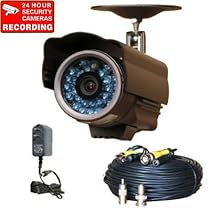
- A CCTV network can only be accessed by display units directly connected to the network. A CCTV network uses coaxial cable, infrared beams or microwaves to broadcast the signal to the connected receivers. This differs from a standard open television network in that anyone tuned to the open network's frequency can access the images being broadcast. With CCTV, the access is restricted.
- CCTV has many practical applications, and it is in use in facilities and homes all over the world. A company may employ a CCTV network as a form of security to monitor the company grounds, and a private residence can employ a CCTV network in the same way. CCTV networks can be used in hospitals to allow nurses to keep an eye on multiple patients at the same time, and they can also be used to monitor traffic at busy intersections.
- The majority of the video cameras used in a CCTV network use cameras that have a charged coupled device (CCD) chip for capturing digital images. This device creates images using small charges of electricity that are emitted when light hits a pixel. Each CCD chip generates hundreds of thousands of pixels that make up the image.
- Each CCTV network has a time-lapse recording device that captures the images and stores them for use at a later time. Many CCTV networks are beginning to implement digital archiving systems that store all of the images on a series of computer hard drives, but many existing CCTV networks use VHS tape as their method of recording. With CCTV time-lapse technology, it is possible to store 24 hours of surveillance on one tape.
- Monitoring CCTV cameras can be done in different ways. In some cases, a CCTV is meant for entertainment purposes, such as the presentation of a boxing match on a pay-per-view network, so these CCTV images are professionally edited for presentation. Most CCTV networks use switchers, quads or multiplexors to keep track of what each camera is capturing. A switcher displays the image from a camera for a few seconds and then automatically switches to the next camera. A quad system feeds images from up to four cameras into one display. The images of each camera in a quad system are recorded separately, but the quality is diminished because they only occupy one-fourth of the screen. A multiplexor is a high-speed switching device that can display and record the images of up to 16 cameras in full-screen mode and quality.
cctv camera , wireless cctv ,cctv security camera, cctv product ,ip cctv ,cctv dvr ,remote cctv ,cctv monitor,cctv surveillance,cctv surveillance camera,cctv home security,cctv camera systems
Showing posts with label Digital CCTV. Show all posts
Tuesday, September 7, 2010
Sunday, September 5, 2010
Sony SSC-DC374 1/3" High Res Color Security Camera
- High quality and high sensitivity - 1/3 type IT DSP CCD with Super HAD™ technology
- High resolution - 480 TV Lines
- Minimum Illumination of 0.8 Lux @ F1.2 (50 IRE)
- On/Off Backlight Switchable
- Turbo AGC (up to 24 dB) for clear, distinguishable images
- Accepts DC Servo lenses
Labels:
CCD,
CCTV,
CCTV Cameras,
Digital CCTV,
Wired CCTV
Wednesday, May 26, 2010
Does target security really monitor there cctv
Closed-circuit television (CCTV) is the use of video cameras to transmit a signal to a specific place, on a limited set of monitors.
It differs from broadcast television in that the signal is not openly transmitted, though it may employ point to point wireless links. CCTV is often used for surveillance in areas that may need monitoring such as banks, casinos, airports, military installations, and convenience stores. It is also an important tool of distance education.
In industrial plants, CCTV equipment may be used to observe parts of a process from a central control room; when, for example, the environment is not suitable for humans. CCTV systems may operate continuously or only as required to monitor a particular event. A more advanced form of CCTV, utilizing Digital Video Recorders (DVRs), provides recording for possibly many years, with a variety of quality and performance options and extra features (such as motion-detection and email alerts).
Surveillance of the public using CCTV is particularly common in the UK, where there are reportedly more cameras per person than in any other country in the world. There and elsewhere, its increasing use has triggered a debate about security versus privacy.
he first CCTV system was installed by Siemens AG at Test Stand VII in Peenemünde, Germany in 1942, for observing the launch of V-2rockets. The noted German engineer Walter Bruch was responsible for the design and installation of the system.
CCTV recording systems are still often used at modern launch sites to record the flight of the rockets, in order to find the possible causes of malfunctions, while larger rockets are often fitted with CCTV allowing pictures of stage separation to be transmitted back to earth by radio link.
In September 1968, Olean, New York was the first city in the United States to install video cameras along its main business street in an effort to fight crime. The use of closed-circuit TV cameras piping images into the Olean Police Department propelled Olean to the forefront of crime-fighting technology.
The use of CCTV later on became very common in banks and stores to discourage theft, by recording evidence of criminal activity. Their use further popularised the concept. The first place to use CCTV in the United Kingdom was King's Lynn, Norfolk.
In recent decades, especially with general crime fears growing in the 1990s and 2000s, public space use of surveillance cameras has taken off, especially in some countries such as the United Kingdom.
Labels:
Analog CCTV,
CCD,
CCTV,
CCTV Product,
CMOS CCTV,
Digital CCTV,
Outdoor ET,
Outdoor Night
Tuesday, May 25, 2010
Video: Woman watches burglary live online via surveillance camera
A Florida woman who had a surveillance camera installed in her home was shocked when she caught two burglars ransacking her house in real time.
Jean Thomas, 43, was at work 25 miles away when she checked her surveillance feed and saw two strangers in her sitting room, stealing her son's Wii game system and eating food they had taken from her fridge.
Mrs Thomas called police and was able to give a running commentary of what was happening in her house as the men walked in and out of the camera's line, carrying her jewellery, television and other belongings.
"I'm watching my home on my online monitor and there's a man in my house and he's robbing it," the Boynton Beach, Florida, resident said in a 911 call. "He's in my bedroom now."
In the footage, released by the Boynton Beach police department, two men, trailed by the family's two dogs and a skittish cat, move from room to room as they sift through the family's property.
Police rushed to the scene and four men - the two filmed inside the house and two suspected accomplices captured nearby - now face charges of burglary and grand theft.
Mrs Thomas bought the surveillance system after her home was burgled last October.
Until Wednesday, however, the £200 investment had yielded little other than hours of footage monitoring the daily movements of the family's pets.
Labels:
Analog CCTV,
CCD,
CCTV,
CCTV Cameras,
CCTV Product,
Digital CCTV,
Outdoor ET
Monday, May 24, 2010
One crime solved for every 1,000 CCTV cameras, senior officer claims
Just one crime is solved a year by every 1,000 CCTV cameras in Britain's largest force area, it was claimed today.
A senior Scotland Yard officer, Detective Chief Inspector Mick Neville, warned police must do more to head off a crisis in public confidence over the use of surveillance cameras.
DCI Neville said officers need to improve their results to make captured images count against criminals.
He said there are more than a million CCTV cameras in London and the Government has spent £500 million on the crime-fighting equipment.
But he admitted just 1,000 crimes were solved in 2008 using CCTV images as officers fail to make the most of potentially vital evidence.
Writing in an internal report, Mr Neville said people are filmed many times every day and have high expectations when they become victims of crime.
But he suggested the reality is often disappointing as in some cases officers fail to bring criminals to justice even after they are caught on camera and identified.
DCI Neville said CCTV played a role in capturing just eight out of 269 suspected robbers across London in one month.
Critics of Britain's so-called ''surveillance state'' will seize on DCI Neville's comments as further evidence CCTV is not working in the fight against crime.
The Government is considering whether every camera should be registered on centrally-held CCTV maps.
Earlier this year a Home Office report found camera schemes have a ''modest impact'' on reducing crime.
Researchers found cameras were most effective in preventing vehicle thefts and vandalism in car parks.
Some local authorities have been forced to make freedom of information requests to police forces to try and work out if CCTV cameras are effective.
The Metropolitan Police is piloting a scheme, known as Operation Javelin, to improve the use of images from existing cameras.
Staff in 11 boroughs have formed dedicated Visual Images Identification and Detection Offices (VIIDO).
They collect and label images before passing them to a central circulation unit that distributes them to officers, forces and the media.
Some 5,260 images have been viewed so far this year with identification made in more than 1,000 cases.
DCI Neville said the scheme should be expanded to force-wide as officers make the investigation of CCTV evidence as professional as fingerprints and DNA.
David Davis, the former shadow home secretary said it is ''entirely unsurprising'' that the report highlights some shortcomings of CCTV.
''It should provoke a major and long overdue rethink on where the Home Office crime prevention budget is being spent," he said.
''CCTV leads to massive expense and minimum effectiveness. It creates a huge intrusion on privacy, yet provides little or no improvement in security.
''The Metropolitan Police has been extraordinarily slow to act to deal with the ineffectiveness of CCTV, something true both in London and across the country.''
Detective Superintendent Michael McNally, who commissioned the report, said improvements in the use of CCTV can be made.
He told Sky News: ''There are some concerns, and that's why we have a number of projects that are on-going at the moment.
''CCTV, we recognise, is a really important part of investigation and prevention of crime, so how we retrieve that from the individual CCTV pods is really quite important.''
A Metropolitan Police spokesman said: ''The Metropolitan Police is currently the only police service to employ this method of CCTV tracking.''
Labels:
Analog CCTV,
CCTV,
CCTV Cameras,
CMOS CCTV,
Digital CCTV,
HDC500,
SONY CCD,
Wide Angle,
Wired CCTV,
Wireless CCTV
Sunday, May 23, 2010
Paris to quadruple number of CCTV cameras
Paris will quadruple the number of closed-circuit police cameras in its streets by the end of next year, after President Nicolas Sarkozy's promise to emulate London in an attempt to track crime and terrorism threats.
By Henry Samuel in Paris
Published: 1:47PM BST 16 Oct 2008
While the Paris metro and rail networks already operate around 9,500 CCTV devices, police have only 330 at their disposal to survey outside public areas. The new plan, dubbed "A Thousand Cameras for Paris", will raise that number to more than 1,200 – with most installed in high-risk areas and outside railway and underground stations.
The figure is still small compared with London, where each citizen is caught on average several hundred times a day. Britain has about four million closed-circuit security cameras compared with France's 340,000.
The CCTV drive follows Mr Sarkozy's pledge last autumn to follow London's surveillance lead. "I am very impressed by the efficiency of the British police thanks to this network of cameras," the French president said. "In my mind, there is no contradiction between respecting individual freedoms and the installation of cameras to protect everyone's security."
Until now, large meeting places such as the Place de la République, where strike protests usually start, and the busy Champs-Elysées were already heavily equipped.
But police want to beef up surveillance outside the Gare du Nord – where the London to Paris Eurostar terminates – the scene of several gang battles in recent months.
It will increase on the Champ-de-Mars – the area around the Eiffel tower – where violent youths recently attacked a group of students celebrating the end of their baccalaureate exams.
More cameras will be installed in the 19th arrondissement, where a Jewish youth was killed in June in an apparent anti-Semitic attack, as well as in the 18th arrondissement – home to Montmartre and the Sacré Coeur.
Paris's police chief will present the plan to city councillors next week. The capital's Socialist mayor, Bertrand Delanoë, long opposed to CCTV, recognised its effectiveness in fighting crime in his campaign for re-election this year.
"The objective is not to cover every road, every corner of the city, but to put video means where common sense dictates," one of the plan's authors told Le Figaro, which leaked the details.
Many of the current cameras are so low-resolution that the images are unusable in a court of law, local politicians say. Interior minister Michèle Alliot-Marie will draw up a charter to go with the new generation of cameras, limiting to 30 the days recorded images can be stored. There will be strict controls on who is allowed to view them.
French police also hope a mini spy-in-the-sky drone the size of a toy glider will help them track rioters and fight crime.
Labels:
CCD,
CCTV,
CCTV Product,
Digital CCTV,
SONY CCD,
SVAT VU5,
Wide Angle,
Wired CCTV,
Wireless CCTV,
YY_F25A530
Saturday, May 22, 2010
CCTV only effective at cutting car crime
CCTV is only effective in cutting vehicle crime and has little effect in reducing other offences, research for the Home Office has found.
The review of a series of CCTV studies revealed cameras that flood town centres and housing estates do not have a significant impact on crime.
In one city, it only led to increased reporting of offences to the police.
It will renew fears over the role of the CCTV network in the UK, which is already the largest in the world with the equivalent of one camera for every 12 people.
An analysis of 44 research studies was carried out by the Campbell Collaboration, a review body, which found that while cameras have a modest impact on crime levels, they are at their most effective in reducing car crime in car parks, especially when used alongside improved lighting and the introduction of security guards.
The authors, who include Cambridge University criminologist David Farrington, said CCTV should continue to be used but have a much narrower focus, such as reducing vehicle crime.
Results from a 2007 study in Cambridge which examined 30 cameras in the city centre found they had no effect on crime but did lead to a rise in the reporting of assault, robbery and other violent crimes to the police.
However, the Campbell Collaboration stressed that CCTV is more effective in reducing crime in Britain than in other countries.
It said CCTV is now the single most heavily-funded crime prevention measure operating outside the criminal justice system adding: "Over the last decade, CCTV accounted for more than three quarters of total spending on crime prevention by the British Home Office."
Chris Grayling, the shadow home secretary, said: "CCTV has definitely got a role to play in combating crime but its use should be decided by local communities."
Labels:
CCTV Cameras,
CCTV Product,
CMOS CCTV,
Digital CCTV,
Outdoor ET,
Outdoor Night,
SVAT VU5
Thursday, May 20, 2010
Seven of ten murders solved by CCTV
Almost seven out of ten murders are solved using footage captured by CCTV cameras, The Daily Telegraph can disclose.
By Richard Edwards, Crime Correspondent
Published: 4:34PM GMT 01 Jan 2009
The first study of its kind into the effectiveness of surveillance cameras revealed that almost every Scotland Yard murder inquiry uses their footage as evidence.
In 90 murder cases over a one year period, CCTV was used in 86 investigations, and senior officers said it helped to solve 65 cases by capturing the murder itself on film, or tracking the movements of the suspects before or after an attack.
In a third of the cases a good quality still image was taken from the footage from which witnesses identified the killer.
Britain has more cameras in public spaces than any other country in the world – an estimated 4.2 million – and a person can be captured up to 300 times a day by CCTV in London. However the proliferation of the spy systems has caused controversy, with civil rights campaigners criticising the creeping growth of a "surveillance society" that is invading the privacy of law-abiding citizens.
A report by the Surveillance Studies Network said that £500 million of public money had been invested in CCTV over the last decade and that during the 1990s the Home Office spent 78 per cent of its crime prevention budget on installing cameras.
However no study had ever been conducted to determine their effectiveness and some anecdotal evidence had previously suggested that they were of little investigative value.
Commander Simon Foy, Scotland Yard's head of homicide, told the Daily Telegraph that the results of his study proved that CCTV cameras are as vital to detectives as forensic evidence such as DNA samples or fingerprints.
Mr Foy said: "CCTV plays a huge role in helping us investigate serious crime. I hope people can understand how important it is to our success in catching people who commit murder."
One of the most infamous cases is that of Richard Whelan, who was stabbed to death on a bus in 2005 as he attempted to defend his girlfriend. The horrific 33-second attack was all caught on camera. Anthony Joseph, a paranoid schizophrenic, baited the victim by throwing chips at his girlfriend and the killer grinned at a CCTV camera as he left the bus.
Labels:
Analog CCTV,
CCD,
CCTV,
CCTV Cameras,
CCTV Product,
CMOS CCTV,
Digital CCTV,
Outdoor ET,
Outdoor Night
Wednesday, May 19, 2010
Uk has more cctv than anywhere else
Britain has become a bureaucratic and authoritarian state watched over by a quarter of the world's CCTV cameras, a study of Labour's decade in power claims.
National debt is running at £175,000 per household, five times more than thought, while each year the Government has passed 3,500 regulations, along with 100,000 pages of rules and explanation.
'The Rotten State of Britain' claims to be the first "deeply researched factual account" of Tony Blair's and Gordon Brown's time in office.
The author Eammon Butler, a director of the leading think tank the Adam Smith Institute, claimed that his book had been turned down by two publishers because of the "unconventional" nature of the content.
He said: "A new form of centralised government and authoritarian government has been created that is worse than ever in Britain's recent history."
Among the claims in the book are that Britain has a quarter of the world's CCTV cameras, the largest of any country and that taxes have risen by 51 per cent since 1997.
Mr Butler also claims national debt is running at £4.6 billion, or £175,000 per household, not £729 billion (£29,000 per household) as the Government claims.
In the audit of 10 years of the Labour Government, Dr Butler says that there are now 1,406 litter wardens and dog catchers who have been given powers to levy on the spot fines.
Dr Butler said he wrote the book because he got "so angry about the way that they have no concept of the rule of law".
Dr Butler found that in just one year – 2006/7 – half of the 722,464 DNA samples collected by the police came from children, including a seven-month year old girl.
One in nine hospital patients picks up an infection during their stay on a ward, while the total cost of outstanding claims against the NHS is £9.2 billion, Dr Butler claimed.
He said that 30,000 of the 200,000 people who die of cancer and strokes each year would survive "if they lived anywhere else in northern Europe".
Dr Butler also claimed in the book that the number of people receiving state benefits has risen from 17 million people in 1997 to 21 million people by 2007.
He found that nearly six million families receive £16 billion-worth of child credit. Dr Butler said: "It's ridiculously high number of beneficiaries for something aimed to help the poorest."
The result is that some families would be better off if the parents did not live together.
He said: "Three-quarters of the poorest households would be better off splitting up. And when money is tight, that is exactly what happens."
Labels:
Analog CCTV,
CCD,
CCTV,
CCTV Cameras,
CCTV Product,
Digital CCTV,
Outdoor Night,
Wired CCTV,
Wireless CCTV
Tuesday, May 18, 2010
What Is CCTV?
Closed circuit television, or CCTV, is used in different situations all over the world, and there is a good chance that most people have appeared on a CCTV network, whether they intended to or not. Most retail businesses employ a CCTV system to keep track of each customer that enters a store, deterring theft and vandalism.
Labels:
Analog CCTV,
CCD,
CCTV,
CCTV Cameras,
CCTV Product,
CMOS CCTV,
Digital CCTV,
Outdoor ET,
Outdoor Night
Monday, May 17, 2010
How long do you record cctv cameras in pubs for court
ROCHDALE has twice as many CCTV cameras as Bury and Oldham, research has revealed.
There are currently 170 cameras covering the borough, with the majority in Rochdale town centre, Freehold, Lower Falinge and College Bank.
Footage from the cameras, which record 24 hours a day, is kept for one month and is often used to help convict criminals and produced as evidence during court cases.
But campaign group Big Brother Watch, which released the report after sending a Freedom of Information request to every council in the country, claims the network is expensive and ineffective.
Director Alex Deane said: "People in Rochdale will rightly be wondering why they're being watched so much more than their neighbours in Bury and Oldham, and why their council decided to spend so much more of their taxpayer money on CCTV.
"The Metropolitan Police have said that only one crime is solved for every 1,000 cameras and there is no evidence to suggest that this kind of heavy surveillance is as good as spending the money getting officers back on the beat."
Despite the installation of each camera going through a strict-decision making process the council could not release the cost for the running and maintenance of the system.
Councillor Ted Flynn, cabinet member for Community Safety, said: "Our fixed cameras were bought and installed many years ago.
"The price of our cameras varies greatly and so does the installation costs. There's a strict decision-making process that assesses the needs of an area before deciding on what type of camera is needed to make sure it's an effective and worthwhile investment.
"Our preference is to use mobile CCTV that can be deployed to our crime hotspot areas in response to a sudden spike in incidents.
"Nowadays we tend to use these cameras a lot more and find that it's been very successful in helping us to reduce crime and make hotspot areas safer by deterring and catching troublemakers.
"We also know that their presence is a great reassurance to the public."
A new code of practice was launched by private company Safe Guard, which controls the majority of CCTV cameras in Rochdale, at the end of last year.
The code asked the police to submit a report every two years, with the first one expected in 2011, indicating the impact CCTV has had on crime, a comparison of crime in areas without CCTV and carry out formal consultation with business premises.
It will be the first report of its kind to be published.
Superintendent Martin Greenhalgh said: "CCTV forms an integral part of our investigation process.
"It is a tool that is used on a daily basis for lines of enquiry and is something we welcome.
"Our cameras are predominantly used in town centre locations and provide reassurance to the community. They can help in reducing crime and disorder and support investigations.
"We take crime fighting seriously and the cameras across the borough help us in doing this effectively."
Labels:
Analog CCTV,
CCTV,
CCTV Cameras,
CCTV Product,
Digital CCTV,
Outdoor Night,
Wired CCTV,
Wireless CCTV
Thursday, May 13, 2010
1/3" SONY CCD IR Color Infrared CCTV Camera Outdoor with Free Camera Power Supply And 100ft Video Power Cable free surveillance DeCal IR40SKC 1OF
Product Description
Infrared Lenses are special designed for use with Day/Night cameras. They eliminate focus shift in the night mode, especially in the presence of IR lighting. IR lenses' employment of advanced optical designs and special glass, eliminates the shifts of focus point in Day and Night. Rays of light from both spectrums are focused onto the same focal plane, resulting in sharp images for IR cameras. The Supra IR is an all-in-one, day/night camera that captures images in all lighting conditions, with a built-in long range IR illuminator. The camera provides color images in bright lighting conditions, and automatically adjusts to black-and-white images when the light level drops. Even in complete darkness, the Supra IR provides clear, accurate images with the support of 26 infrared illuminators. The Supra IR camera has a weatherproof housing and sunshield. It comes fully assembled, pre-wired and pre-focused for easy installation and the new Universal Bracket provides for quick pan/tilt camera adjustment. All brand new in box. Note: This camera not made by SONY, it uses SONY Super HAD CCD image sensor and SONY DSP technology, made by one of the world largest OEM manufactures. Free universal mounting bracket and 12vdc 500mA regulated UL listed power supply included, and free 100ft video power camera cable .Product Details
- Amazon Sales Rank: #26383 in Consumer Electronics
- Brand: DIGIAIR
- Model: 1OF
Features
- 1/3" Sony CCD Technology;420 TV lines high resolution;Water, dust and crush resistant glass coating
- Infrared Lenses f 3.6mm super wide angle;0 lux with IR LED
- Built in IR illuminator effective up to 54 feet 35 °and light senor;Dimensions (L x Dia.) 5" x 2.5"
- Video out:composite output 1.0Vp-p at 75-ohm;Electronic shutter 1/50 - 1/12000 seconds;Auto iris AES
- Free universal mounting bracket and 12vdc 500mA regulated UL listed power supply included, free 100ft video power camera cable ; free 1 DeCal 3"x2"
Labels:
CCTV,
CCTV Cameras,
CCTV Product,
Digital CCTV,
SONY CCD,
Wireless CCTV
Wednesday, May 12, 2010
Clover Electronics HDC500 Super High-Resolution Indoor/Outdoor ET Security Camera with 180 degree Coverage - Small (Dark Grey)
Product Description
Product Details: Super Hi-Res Dual Lens ET Camera Produces Extraordinary Picture Quality; Perfect for Viewing Hallways and Expansive areas; Offers Two Separate Cameras in One Housing; Rugged Steel Weather-Resistant Construction; Improved Circuitry for a Better CCTV Camera; Camera Covers 180° Angle of View Without any Blind Spots for a Panoramic View when Used with a Quad Splitter or DVR; Comes Complete with Hardware Accessories Kit, Attached Universal Mounting Bracket, 100' Long Cable and Instruction Manual Product Specifications : Image Sensor: 1/3" Sony Super HAD CCD, 510H x 492V; Scanning System: 525 Lines, 2:1 Interlace; Horizontal Resolution: 420 TV Lines; Shutter Speed: Auto, Manual (1/60 to 1/100,000 sec); Sync. System: Internal; S/N Ratio: More than 46db (AGC off); Minimum Illumination: 0.1 Lux / LEDs off; Video Output: Composite 1.0Vp-p @75 Ω; AGC: Auto; White Balance: Auto; Lens: 3.8mm + 3.8mm Fixed Lens (180°); Current Consumption: 200mA Max @DC12V; Power Supply: DC 12V, 250mA; 54" Lead for Easy Installation; Operating Temperature: 14°F to 122°F For Additional Product Specifications Please Contact Customer Service at 877-327-5000Product Details
- Color: Gray
- Brand: Clover
- Model: HDC500
- Number of items: 1
- Dimensions: 12.00" h x 6.00" w x 15.00" l, 5.82 pounds
Features
- Panoramic color
- Panoramic e.t. color camera; sony 1/3 super had; resolution: 420 tv lines; 0.01 lux at f1.2; vandal resistant &
- Rugged steel construction; covers 180º angle of view without blind spot; connect video output 1 & video output 2 to channel 1
Labels:
Analog CCTV,
CCTV,
CCTV Cameras,
CCTV Product,
CMOS CCTV,
Digital CCTV,
HDC500,
Outdoor ET,
Wireless CCTV
Avermedia NV5000 120 Frames Per Second Video Capture Card with Surveillance Software
Product Description
Product Details
- Amazon Sales Rank: #37479 in Consumer Electronics
- Brand: AverMedia
- Model: NVDNV5000
- Format: CD
- Number of items: 1
- Dimensions: 3.00" h x 8.40" w x 11.80" l, 2.00 pounds
Labels:
Analog CCTV,
CCTV,
CCTV Cameras,
CCTV Product,
Digital CCTV,
Wired CCTV,
Wireless CCTV
Q-See QSM0S 8-Inch Color LCD Monitor with Speakers
Product Description
This 8" LCD Flat monitor can be connected to your Satellite TV or HDTV, your Cameras and DVR's systems, Video Games and PC Computers at the same time and display them with an easy touch button menuProduct Details
- Amazon Sales Rank: #1077 in Camera & Photo
- Brand: Q-See
- Model: QSM0S
- Dimensions: 10.00" h x 6.00" w x 8.00" l, 3.00 pounds
Features
- 8" Color LCD Mini Monitor
- Wide view angle and Color quad mode
- Resolution: 1440 (H) x 468 (V)
- Directly connect to CCTV security camera's, DVR, or Quad Processor
- Loudspeaker
Customer Reviews
Good enough for the price pointIt is a good product but instructions were very poor, esp. for a wall mount. I even called QSee tech support before purchase to ensure it can be wall mounted and I can remove the desk stand, it turned out that they too scrambled to find that information for me. Out of the box it is meant for installing on the desk, however, I struggled for a long time to figure how to install it on the wall. I found a small threaded hole at the bottom of the unit, luckily found a right size screw to get in there and secure it with a L shaped bracket (I had to cut the bottom leg to the right size so it wasn't protruding out) and neon washer. Althought the installation is very secure now but I just hope it stays in place. I wish they had provided wall mounting hardware because I wasted lot of time and made numerous trips to Lowes/HD.
Labels:
CCTV,
CCTV Cameras,
CCTV Product,
Digital CCTV,
Wireless CCTV
Monday, May 10, 2010
How to chose a good CCTV Security Camera Surveillance System
In the past few years the need for CCTV security surveillance systems has increased, wither its for your home or your business CCTV technologies have proven to increase security. and Just like any other technology now a days, CCTV systems are way more affordable that they used to be, but first what makes a good CCTV security camera system?
Instructions
Instructions
- Step1The number of Frames Per second your DVR (Digital Video Recorder) is capable of handling. First understanding what that means, A real time second of video is 30 Frames. so a recorded second or video motion that doesn't skip is 30 Frames. So if your CCTV camera system is capable of handling 30fps that means you can record only one camera real time otherwise the 30fps will be divided into how many cameras they system might support. So when looking for a good CCTV Surveillance system make sure you get a system that does 30fps for each camera. so if you are looking for a 4 a good CCTV security camera system look for a 120fps DVR capable.
- Step2TV Lines supported by the CCTV cameras. A CCTV camera's quality is measured by TV Lines, which is the number of horizontal TV lines the camera produces, and of course the higher the clearer and better picture. the average quality is 400TVL, 420TVL is good picture quality, 480TVL is higher quality and more is even Better. keep in mind that TV Lines is what mainly controls the price of the CCTV camera.
- Step3The Resolution of which the DVR does display and record. which is the original dimensions in pixels of the displayed or recorded video Such as 160x120, 320x240 and 640x480 and the higher is the better.
- Step4The HDD capacity of the CCTV DVR. which basically means the number of recorded previous days of video that the DVR will keep before recycling. most CCTV systems by default record video based on motion which means if there is no motion there is no recording because practically it will be a still image rather than video. the average for a 4 camera system is between 160GB and 250GB and the higher the more days of recorded video (motion) your DVR system keep.
- Step5Remote capability. Now a days a standard CCTV camera systems are remote view capable. which means you can view your cameras remotely and virtually from anywhere in the world using the internet using internet explorer or using a remote client that is installed on the PC your accessing the DVR from.
- Step6Back up and recovery compatibility. CCTV camera systems give you the ability to back up desired video period either on CD-R, DVD-R or USB storage including USB flash drives. Making it easy to export video to other devices for many various reasons. for example making a copy for the police or the insurance company.
Labels:
Analog CCTV,
CCTV,
CCTV Cameras,
Digital CCTV,
Wired CCTV,
Wireless CCTV
Subscribe to:
Posts (Atom)